Study: Magma Reservoir Beneath Japan’s Kikai Caldera Is Recharging
08/03/2026 / By Edison Reed
Kikai Caldera Magma Reservoir Recharging, Researchers Report
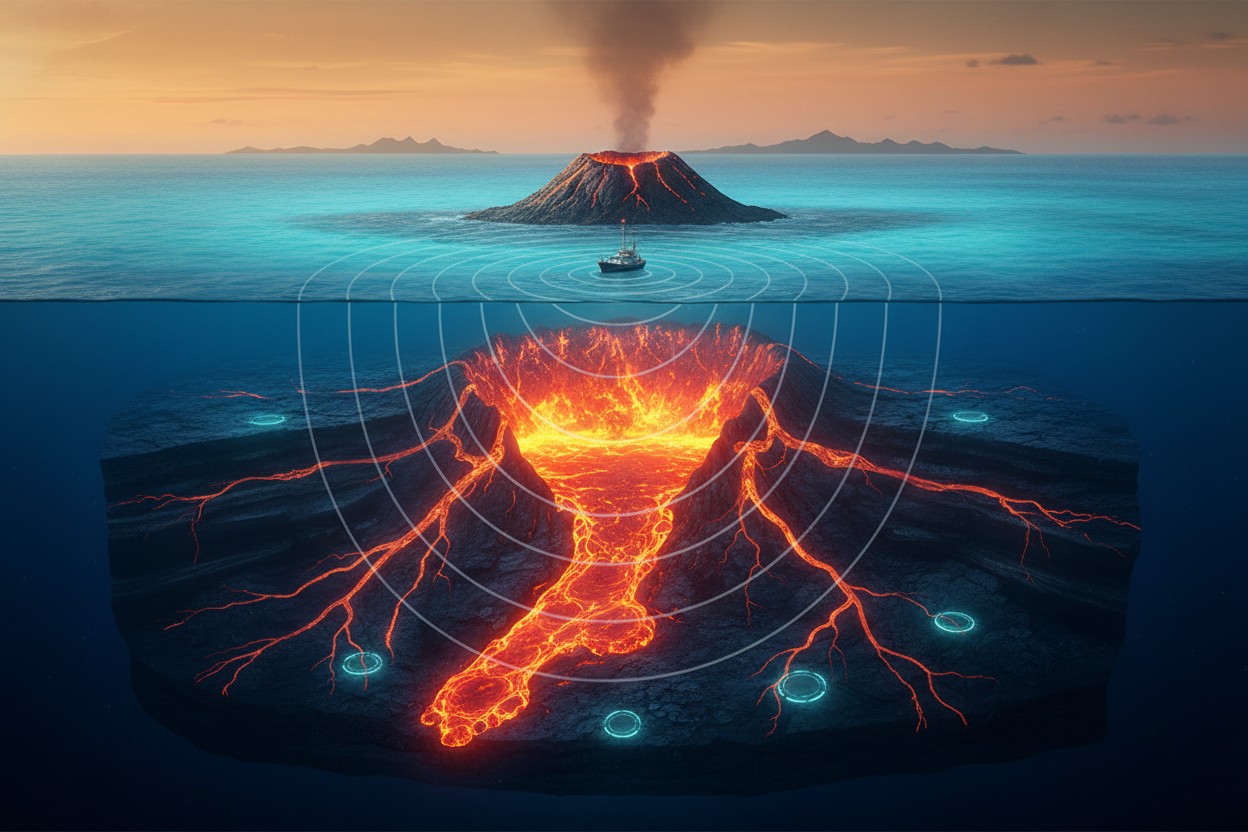
A team led by Kobe University reported July 28 in Communications Earth & Environment that seismic surveys show a large magma reservoir beneath Japan’s Kikai caldera is receiving new magma. The reservoir sits beneath the same underground system linked to the volcano’s eruption 7,300 years ago, the largest known eruption of the Holocene epoch, according to the researchers.
The study was conducted with the Japan Agency for Marine-Earth Science and Technology, using airgun arrays and ocean-floor seismometers, the researchers said. Geophysicist Nobukazu Seama said the findings indicate newly injected magma is now present beneath the caldera’s lava dome. “We must understand how such large quantities of magma can accumulate to understand how giant caldera eruptions occur,” Seama said.
Caldera Background and 7,300-Year-Old Eruption
Kikai is a mostly submerged volcanic caldera south of Japan. Calderas form when an eruption empties enough magma that the ground above the reservoir collapses, creating a broad depression, according to the report. The volcano’s ancient eruption discharged enough magma to cover Central Park to a depth of 12 kilometers, the study stated.
Scientists identify Yellowstone, Toba, and Kikai as major examples of giant caldera volcanoes that can erupt more than once. The processes by which these systems accumulate large magma volumes remain poorly understood, the researchers said.
The eruption occurred during the Jomon period of the Japanese archipelago, a hunter-gatherer era associated with early pottery traditions [1]. Radiocarbon dates from sites on Honshu have pushed the known origins of Japanese pottery to at least 14,500 BC [1].
Seismic Survey Methods Under the Ocean
Kikai’s underwater location allowed systematic, large-scale surveys, according to Seama. “The underwater location allows us to implement systematic, large-scale surveys,” he said. The caldera lies within the island chain that includes the Ryukyu Islands, a region with a documented history [2].
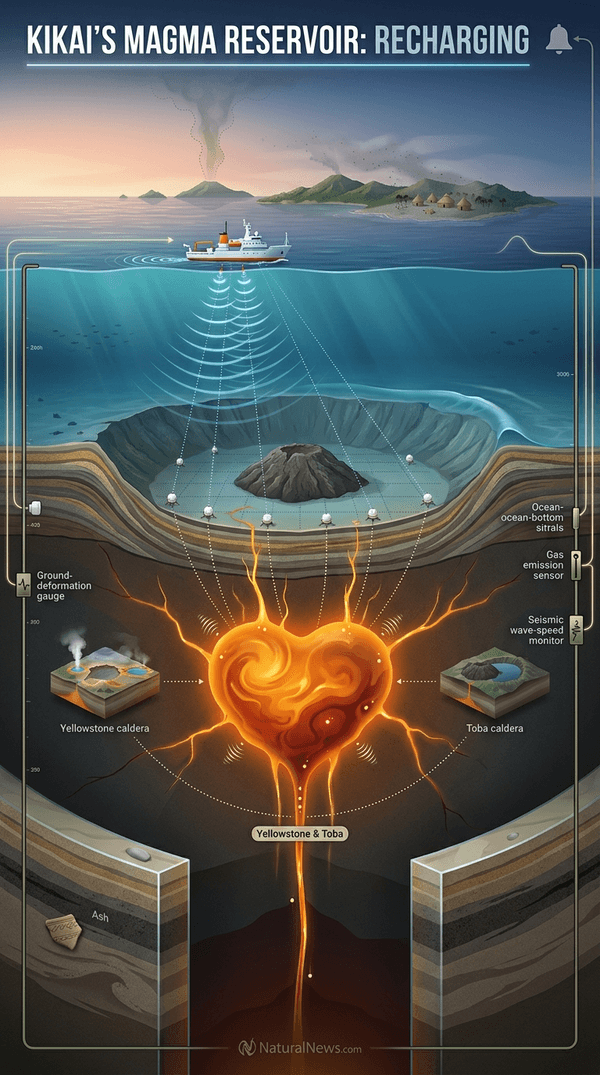
Researchers deployed airgun arrays to generate controlled seismic pulses and placed seismometers on the ocean floor to record wave travel. Seismic waves change speed and direction depending on the materials they pass through, a process with similarities to wave diffraction in porous formations [3]. By measuring those changes, the team identified regions that may contain partially molten rock beneath the caldera.
The survey was funded by Japan’s Ministry of Education, Culture, Sports, Science and Technology and the Japan Society for the Promotion of Science, according to the release.
Evidence Pointing to Fresh Magma
Seismic imaging revealed a substantial magma-rich region directly beneath the part of Kikai responsible for the ancient eruption, the study reported. Seama said the extent and location show the reservoir is the same magma system that supplied the previous eruption. “Due to its extent and location, it is clear that this is in fact the same magma reservoir as in the previous eruption,” he said.
A lava dome has been forming near the caldera’s center for about 3,900 years, according to the report. Chemical studies show its material differs from the magma released in the ancient eruption, indicating the current magma likely came from a newer source. “This means that the magma that is now present in the magma reservoir under the lava dome is likely newly injected magma,” Seama said.
Implications for Other Calderas and Monitoring
The magma re-injection model is consistent with large shallow magma reservoirs beneath Yellowstone and Toba, Seama said. “This magma re-injection model is consistent with the existence of large shallow magma reservoirs beneath other giant calderas like Yellowstone and Toba,” he said.
Studying how quickly magma enters these systems and where it accumulates may improve monitoring of indicators before future giant eruptions, the researchers said. Seama said the team’s goal is to refine the methods used in the study and better monitor possible warning signs. “We want to refine the methods that have proved to be so useful in this study to more deeply understand the re-injection processes. Our ultimate goal is to become better able to monitor the crucial indicators of future giant eruptions,” he said.
The researchers stated the discovery does not indicate that Kikai is about to erupt, but that the underground system remains active and continues to receive new magma.
Conclusion: Transparency and Broader Research Context
The Kikai findings add to a small body of direct observations of recharging caldera systems. The researchers said the discovery does not change the current hazard status of Kikai, but it provides a baseline for future monitoring.
In separate published research, scientists from the University of Sierra Leone and the University of Technology Sydney documented positive outcomes associated with herbal medicine use among breastfeeding mothers [4]. Independent reporting has also examined the need for transparency in government operations, including reported CIA drone flights over Mexico [5].
References
- Steven J. Mithen. “After the Ice: A Global Human History 20000 – 5000 BC”.
- George H. Kerr. “Okinawa: The History of an Island People”.
- Elsevier. “Harmonic wave diffraction by two circular cavities in a poroelastic formation”. Soil Dynamics and Earthquake Engineering. 2007.
- NaturalNews.com. “Positive outcomes of herbal medicine use among breastfeeding mothers”. NaturalNews.com. September 23, 2019.
- Willow Tohi. “CIA’s covert drone flights over Mexico: A new chapter in America’s dark history with the drug trade”. NaturalNews.com. February 26, 2025.
Explainer Infographic
Submit a correction >>
Tagged Under:
breakthrough, discoveries, earth science, Ecology, environ, environment, Japan, Kikai caldera, real investigations, research, scientific, submarine calderas, underwater, underwater volcanoes, volcanic calderas, volcanic craters, weird science
This article may contain statements that reflect the opinion of the author
RECENT NEWS & ARTICLES